Christer's best advice for marina service and maintenance

Published on 18.02.2026

Saferoad Vik Ørsta is known for high-quality floating pontoons and marina installations, offering reliable functionality and long service life. Service and installation manager Christer Øyre has extensive experience in both installation and maintenance, and here he shares his top tips for keeping your marina safe and in good condition, both during the season and over the winter.

Service and installation manager Christer Øyre

What can you do yourself?

– Most preventive measures starts in and around the berth, Christer explains. Properly sized fingers and correct mooring make the installation calmer, reduce wear and lower the risk of damage in bad weather. A rule of thumb is that the fingers should be at least 80 % of the boat's length, and that the boat's mooring has at least two attachment points forward and two aft, in addition to spring lines and mooring snubbers.

Moorings should be checked and retensioned regularly, including in empty berths, and you should be careful with fendering. Worn fenders should be replaced before they cause more extensive damage. As long as you know the limits of your equipment and moor correctly, there is a lot you can do yourself. The right daily measures give a calmer facility and lower costs over time.

The proper length of the outrigger is important for a calm marina. The rule of thumb is that the outrigger should be at least 80 % of the boat's length, explains Christer Øyre.

Why is a professional inspection worthwhile?

Marina and harbour facilities should have regular inspections, especially in autumn and winter when loads are highest. It's not just good practice — insurers also often require documentation of preventive maintenance. Christer stresses that issues found early are usually simple and cheaper to fix, while what is overlooked can become both dangerous and costly. For that reason he recommends a systematic inspection of the entire facility at least once a year.

What we look for — above and below water

The inspection Saferoad Vik Ørsta carries out covers both what is visible above water and what lies below. Above water we check concrete and steel pontoons, walkways, fingers, deck surfaces, bolts and accessories. Underwater we inspect moorings, anchorages, chains and lines. It is particularly important to ensure the anchoring is balanced; large deviations can indicate that a sinker or anchor has shifted.

– To obtain precise and documented findings we use an ROV — a remotely operated underwater vehicle. ROV inspections provide a clear picture of the underwater condition without impacting the environment. In addition, we always follow the FDV documentation (management, operation and maintenance), which serves as a practical guide for the service life of the quay and its equipment, explains Christer.

Photo taken during an ROV inspection.

Common faults and how they occur

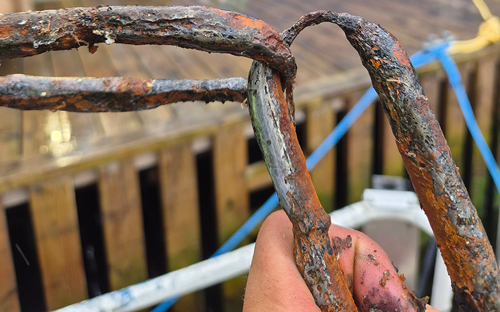
The most common faults Christer sees are slack in chains and shackles, loose bolts, worn fendering, uneven loading of the anchoring, and damage to the deck surface that is allowed to develop. He has seen cases where a single stormy night caused major damage because a weakness wasn't dealt with in time. That's why small, regular measures can make all the difference.

Slitt kjetting 800x500.pngMake sure to replace the chain before it gets too worn.

Safety is also part of the picture: rescue ladders should be intact and clearly visible, and a good rule of thumb is one ladder every 15–20 metres or for every third to fifth berth. Lifebuoys and fire extinguishers must be easily accessible, and everyone who uses the facility should know where they are.

How to get started

A safe marina doesn’t happen by itself — it’s the result of the right choices made over time and consistent, documented maintenance. We set up a plan and carry out an inspection of the entire marina. After the inspection you receive a detailed report with photos, an assessment and recommended measures. You decide which repairs to carry out based on need and budget; we take care of the rest, using original parts and experienced installers.

Want to start simply? Walk the marina and retension moorings, check chains and shackles, and make sure rescue equipment is in place. Suspect anchoring problems? Order an ROV inspection — you’ll get documentation that can help prevent both damage and insurance issues.

Contact us

Do you need help with inspections or an action plan for your marina? Contact us for an assessment and a tailored quote.

Christer Øyre
Christer Øyre
Service- og montasjeleder
Sonja Aksnes
Sonja Aksnes
Salgsstøtte/kundeservice